
Noah Labs Announces New Late-Breaking Data from TIM-HF3 Voice Study

Noah Labs Announces Late-Breaking TIM-HF3 Data: AI Voice Analysis Predicts Heart Failure Hospitalisation a Month in AdvanceKey takeaways:
- The TIM-HF3 Voice study evaluated whether a voice-based AI-powered algorithm using weekly, short vowel recordings could predict heart failure hospitalizations and to compare its performance with standard of care weight-based alerting.
- AI-based voice analysis detected more than twice as many heart failure hospitalizations as daily weight alerts (84% vs 36% sensitivity), with a median of 29 days from alert-to-event and roughly half the alert burden.
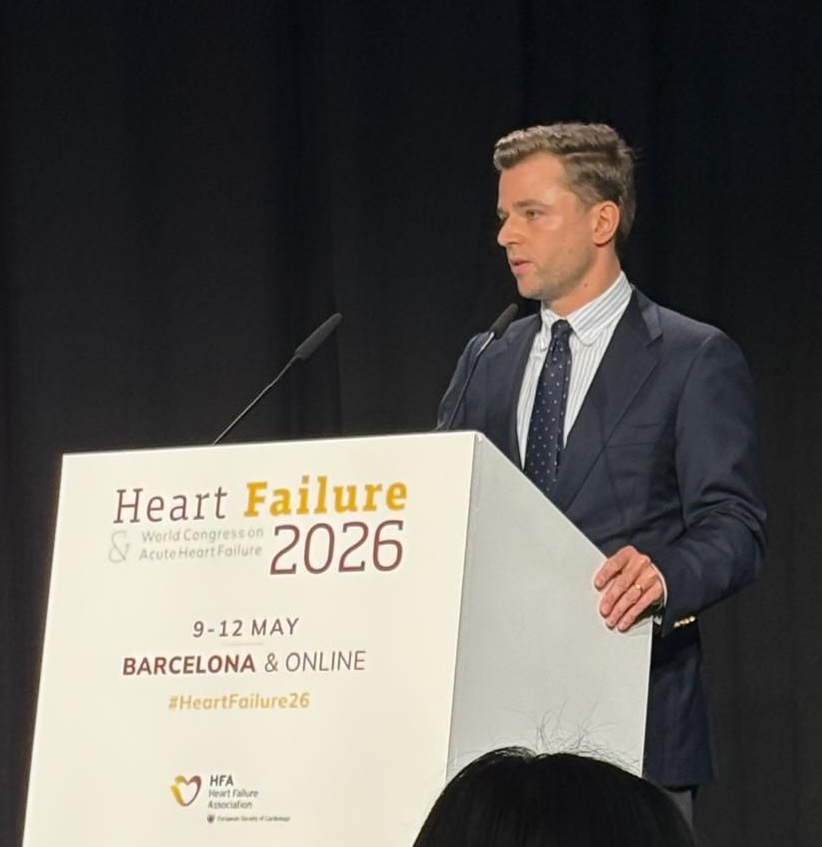
Berlin, Germany – 9 May 2026: A non-invasive voice biomarker developed by Boston- and Berlin-based Medtech company Noah Labs predicted heart failure hospitalizations in outpatients. The algorithm substantially outperformed daily body-weight monitoring on both sensitivity and alert-to-event time on the same patients and events. The results were presented at the Late-Breaking Science presentation at Heart Failure 2026, the annual congress of the Heart Failure Association (HFA), a branch of the European Society of Cardiology. [1]
The prospective TIM-HF3 study (DRKS00028195) was conducted at three German centres. Patients were eligible if they had NYHA class II–III chronic heart failure and a heart failure hospitalisation within the previous 12 months. All patients were enrolled in both monitoring programs in parallel. The first was a structured interventional remote patient monitoring (RPM) programme based on daily transmissions of weight, blood pressure, ECG and self-rated health status, reviewed each day by a cardiologist-led telemedical center. The second was an observational voice-based program in which patients recorded the sustained vowel /i/ weekly on a tablet at home.
The 105 enrolled patients had a mean age of 73.6 years, 27.2% were female, mean left ventricular ejection fraction (LVEF) was 41.0%, and NT-proBNP was markedly elevated (median 3,228 pg/mL).
TIM-HF3 results showed that the voice algorithm detected 21 out of 25 hospitalizations. The algorithm demonstrated a sensitivity of 84% in detecting heart failure hospitalizations, a median alert-to-event time of 29 days (interquartile range 20–72) and an unexplained alert rate of 2.62 per patient-year. In comparison, daily weight-based alerting, evaluated on the same events, detected 9 out of 25 (sensitivity 36%), with a median alert-to-event time of 13 days (IQR 4–25) and an unexplained alert rate of 6.07 per patient-year.
TIM-HF3 Study Principal Investigator, Professor Friedrich Köhler explained: “TIM-HF2 established the value of structured remote patient monitoring in heart failure. TIM-HF3 Voice now shows that voice analysis adds a low-burden detection layer to that framework, with a sensitivity and lead time that conventional non-invasive monitoring alone does not achieve. The next step is to integrate voice into existing remote care pathways and test, in an interventional trial, whether this earlier warning translates into fewer hospitalizations.”
Concluding, Study Presenter and Chief Medical Officer of Noah Labs, Dr. Leonhard Riehle said:
“The TIM-HF3 AI-based voice algorithm demonstrated clinically meaningful performance for the prediction of heart failure hospitalizations in an outpatient setting. The Noah Labs algorithm delivered higher detection sensitivity than weight-based monitoring, with a median 29-day warning window before hospitalization. This is a critical step toward an interventional trial testing whether voice-based early detection translates into fewer hospitalizations and better outcomes for patients with chronic heart failure.”
Noah Labs Press Contact
This press release accompanies a presentation at Heart Failure 2026. It does not necessarily reflect the opinion of the European Society of Cardiology.
Conflict of Interest
Noah Labs developed the voice algorithm evaluated in the TIM-HF3 Voice substudy and conducted the voice biomarker analysis. The TIM-HF3 trial was not financially supported by Noah Labs. Dr. Leonhard Riehle and Marcus Hott are co-founders and shareholders of Noah Labs. Mariam Fouad and Aurele Goetz are employees of Noah Labs. Professor Friedrich Köhler received a research grant from the German Federal Ministry for Economic Affairs and Energy supporting this project. All other contributors declare no conflicts of interest related to this work.
Funding statement
The TIM-HF3 Voice Study was funded by a research grant from the German Federal Ministry for Economic Affairs and Energy.
About Noah Labs
Noah Labs is a Boston- and Berlin-based healthcare technology company dedicated to empowering heart failure patients to live longer, healthier lives by providing the most powerful remote patient monitoring & management globally. Founded in 2021, by Oliver Piepenstock, Marcus Hott, and Dr. Leonhard Riehle, its portfolio includes Noah Labs Ark, a CE-marked remote monitoring platform deployed across European clinical sites. Noah Labs Vox is undergoing clinical validation in partnership with Mayo Clinic, UCSF, Charité Berlin, Maastricht University Medical Center, and Hospital Clínic de Barcelona. The company is also a member of the American Heart Association’s Centre for Health Technology & Innovation and an alumnus of the Google for Startups AI Academy. Noah Labs has received grant funding from the European Innovation Council (EIC) Accelerator.
Regulatory Status
Noah Labs Vox is an investigational device, currently pending CE and FDA clearance. It is not yet available for commercial sale or clinical use outside of approved research settings.
Source
1. 'TIM-HF3: Voice-based prediction of heart failure hospitalisation' presented during the Late-Breaking Science: Innovations in Heart Failure Management session on Saturday 9 May 2026 at 11:21 CEST in Room 3, Heart Failure 2026, Barcelona, Spain.